


Top Force
Century Games Innovation Pte. Ltd.
Top Force is the kind of strategy game I can recommend to someone who wants a straightforward military base-building experience without beginning with a complicated rulebook. I spent time moving through its early progression, organizing troops, improving the base, and learning how its battles connect to the wider development loop. The central appeal is easy to understand: prepare your soldiers, make your base more capable, and use better planning to overcome opposing forces.
That simplicity is useful for a first-time player. You do not need to know a long-running game universe before starting, and the basic objective is clear almost immediately. At the same time, it is not a completely passive experience. The choices you make about preparation, upgrades, and when to push forward affect how smoothly the next stage feels. My overall impression is that it works best as a short-session strategy game for players who enjoy gradual progress rather than one enormous, complex campaign.
What Top Force feels like when you begin
Top Force is a free strategy game from Century Games Innovation Pte. Ltd., with an Everyone age rating. It has reached over 500 thousand installs and carries a 4.5 average from around 11 thousand ratings, which gives a useful indication that its accessible format has found an audience. The current version is 3.4.5, and it runs on Android 8.0 or later.
The opening experience is built around a familiar rhythm: inspect what is available, strengthen your position, prepare your soldiers, and then take on the next challenge. I found that rhythm easy to follow because each action has a visible purpose. When I improved the base, it did not feel like a detached menu exercise; it supported the larger goal of being ready for tougher encounters.
That said, players should set their expectations correctly. This is not the best choice if you are looking for a deep simulation with detailed battlefield control, elaborate diplomacy, or a slow, highly realistic military campaign. Its strategy comes from managing progression and making sensible preparations, not from commanding every individual movement like a traditional desktop war game.
Related News






The game is more comfortable for people who enjoy checking in regularly, completing a few useful actions, and returning later with a stronger position. I would especially suggest it to someone who likes watching a base gradually become more capable. If you prefer a single-player game with a fixed ending and no emphasis on repeated advancement, a premium strategy title may suit you better.
Starting without wasting early resources
On the first launch, I recommend resisting the urge to spend every available resource immediately. The early screens are designed to make progress feel quick, but that can encourage rushed decisions. I found it more useful to look at the entire base and identify which improvement supports the next practical objective rather than choosing the first attractive upgrade.
A good first-session habit is to separate actions into three groups: what helps you act now, what prepares you for the next battle, and what simply makes the base look more developed. The first two deserve priority. This small distinction prevents a common beginner mistake: improving several unrelated parts of the base while leaving the military preparation needed for the next encounter behind.
Gallery
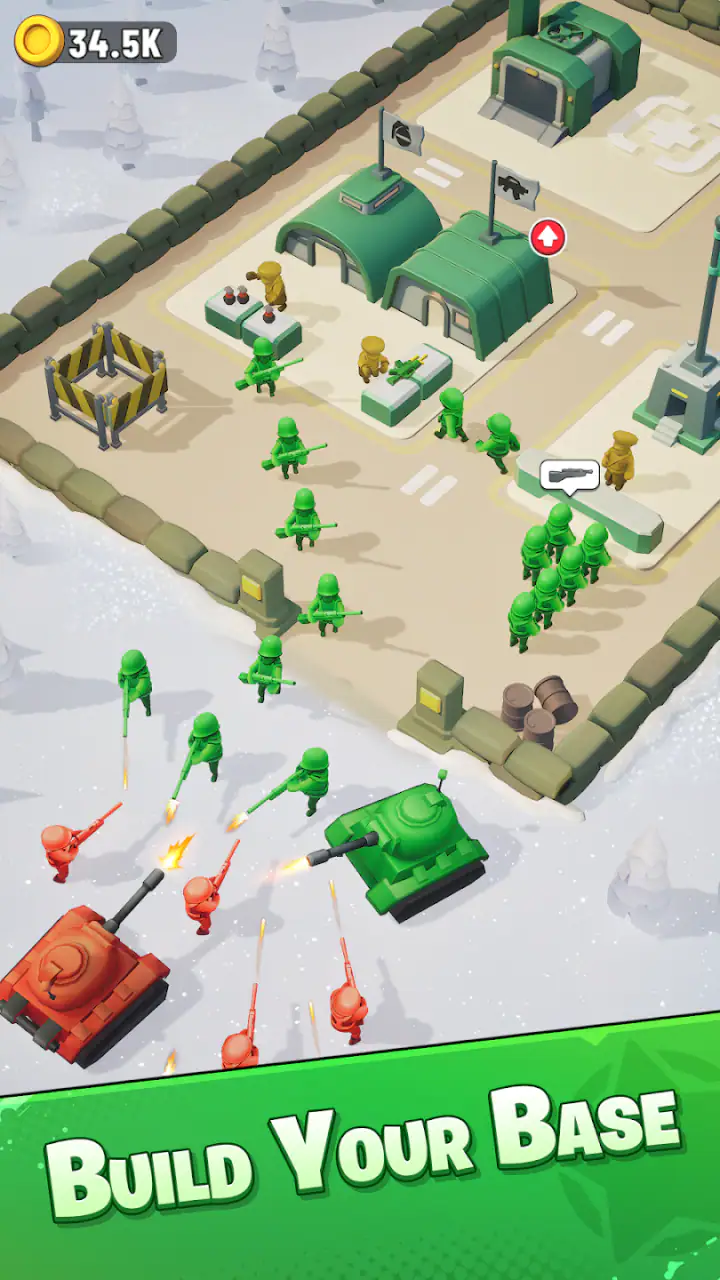
The interface is approachable, but there are still moments when a new player may tap through instructions too quickly. I suggest reading the wording around each new action, especially when the game introduces a new part of the base or a new way to strengthen soldiers. Even when a button looks obvious, the surrounding explanation often tells you what the action is meant to support.
Another useful approach is to treat the opening as a guided tutorial rather than a race. Let the early tasks show you the intended order of operations. Build an understanding of how preparation leads into combat, then how combat feeds back into base growth. That mental map is more valuable than trying to move through the first screens as fast as possible.
How I reached the first meaningful success
My first satisfying moment came when I stopped treating each battle as an isolated tap and started preparing for it in advance. Instead of entering the next encounter as soon as it appeared, I checked whether my soldiers and base were in a reasonable state. That pause made the result feel earned, even though the early stages are designed to be accessible.
For a new player, the practical sequence is simple. First, complete the immediate task that introduces the game’s basic loop. Next, use the resulting progress to improve the part of the base that directly supports your next action. Then check your available soldiers before committing to another fight. This order reduces the chance of reaching a battle with an underprepared force and having to repeat earlier work.
The important insight is that a successful action is not always the action that produces the biggest visible number. Sometimes the better move is the one that leaves you with more flexibility for the following step. For example, an improvement that supports repeated progress can be more useful than a one-time boost that looks impressive but does not help with the next obstacle.
I also found that short pauses between actions improved my decisions. The game encourages a quick tempo, but there is no advantage in tapping through every available option without checking the result. After each meaningful upgrade or battle, take a moment to see what has changed. This makes it easier to notice which part of your routine is actually helping and which choice was merely convenient.
That advice matters because the first successful battle can create false confidence. A player may assume that the same preparation will always be enough. In practice, the sensible habit is to reassess before each new challenge. The base, the available soldiers, and the immediate objective should be considered together rather than relying on one upgrade as a universal solution.
Where new players are likely to get confused
The biggest source of confusion is the relationship between base development and military progress. It is tempting to view them as separate activities: improve the base when you have spare time, then fight whenever a battle is available. I had a smoother experience once I viewed them as two halves of the same system. The base creates the conditions for stronger preparation, while successful encounters give your overall progress direction.
Another potentially confusing point is deciding whether to continue immediately or pause and strengthen your position. The game’s accessible presentation can make every next action look equally urgent. It is worth asking a practical question: will this choice help me handle the next challenge, or am I only choosing it because it is currently available? That question is simple, but it prevents a lot of inefficient clicking.
Players may also wonder how much attention they should give to every available option. My advice is not to chase everything at once. Focus on the objective that is closest to producing a meaningful result, then return to secondary improvements when your main path is stable. This keeps the early game readable and avoids turning the base into a collection of unfinished priorities.
The free-to-play structure is another point worth understanding before investing serious time. The game is free to download and includes in-app purchases ranging from $0.99 to $99.99 per item. I would approach those purchases as optional conveniences rather than part of the basic learning process. A first-time player should spend enough time understanding the normal progression before deciding whether any paid item genuinely improves the experience.
This is also where Top Force differs from a completely premium strategy game. A paid alternative may offer a more controlled pace and fewer prompts connected to optional spending, while this game is easier to try without an upfront purchase. The trade-off is that players who want uninterrupted progression may find the free-to-play structure less comfortable over a long period.
Small habits that make progression clearer
One of the most useful habits is to make a quick plan before opening several upgrade choices. Decide whether your immediate goal is a stronger force, a more capable base, or simply completing the next available objective. This prevents the common problem of spreading progress too thinly across unrelated improvements.
A second tip is to use battles as tests of preparation, not just as rewards. If an encounter goes well, note what you had ready beforehand. If it feels difficult, do not automatically repeat the same approach. Look back at the preparation stage and identify whether the problem came from acting too soon, neglecting the base, or failing to align your available soldiers with the task ahead.
A third insight is that the game is well suited to a predictable daily routine. In an ordinary scenario, I could open it during a short break, review the base, complete one meaningful improvement, and decide whether the next battle was worth attempting immediately. That routine is more satisfying than opening the game with no plan and tapping through every highlighted option.
This short-session style also makes it easier to control spending. When you know exactly what you want to accomplish during a visit, you are less likely to treat every delay as a reason to purchase something. I would recommend setting a personal rule before playing: learn the normal route first, and only consider an in-app purchase after you understand what problem it solves for you.
Another trade-off is the balance between convenience and involvement. Top Force is approachable because it does not demand that every decision be deeply technical. However, players who enjoy highly detailed optimization may eventually want more control than this format provides. Its strength is the clear connection between preparation, base growth, and winning; its limitation is that the strategy remains focused rather than endlessly granular.
Who will enjoy it, and who should skip it
I think Top Force is a good match for casual strategy players, newcomers to base-building games, and anyone who likes seeing a military-themed project grow in manageable steps. It is also suitable for people who prefer learning through action instead of studying a large collection of systems before they can play effectively.
The Everyone rating makes it approachable for a broad audience, but age accessibility does not mean every player will enjoy the same design. Someone seeking sophisticated competitive depth, detailed unit customization, or a campaign built around a strong narrative may find the experience too streamlined. In that situation, a more specialized strategy game would be a better choice.
I would also skip it if your main requirement is a game that can be completed once and then put aside. The appeal here comes from continued development, repeated preparation, and gradual improvement. If that loop sounds repetitive to you, the free entry point will not change the fact that the core experience is built around ongoing progression.
On the other hand, players who like having a clear next task may appreciate the structure. I rarely felt completely lost because the game keeps pointing toward the next useful action. The challenge is not discovering an unknown objective; it is choosing the most sensible way to prepare for it without wasting effort.
How it compares with familiar strategy alternatives
Compared with a traditional real-time strategy game, Top Force feels lighter and more focused on development than on direct battlefield micromanagement. You are not approaching it for the same reason you would play a complex PC strategy title. The attraction is the compact loop of improving your position and taking on the next enemy, with less pressure to control every second of an encounter.
Compared with a purely casual base-building game, it gives military preparation a more central role. The base is not only decorative or administrative; it is tied to your ability to move forward. That connection gives upgrades a clearer purpose, although it also means that players who ignore preparation may feel the effects when they try to advance too quickly.
Compared with premium mobile strategy games, the free price makes Top Force easier to test. You can discover whether the progression loop suits you before committing money at the start. The compromise is the presence of optional purchases, priced from $0.99 to $99.99 per item, which may make the long-term experience feel less predictable for players who prefer a one-time purchase.
My recommendation is therefore quite specific. Choose this game if you want an accessible strategy routine with a military theme, a growing base, and clear short-term objectives. Choose something else if you want a complex simulation, a fixed premium campaign, or deep control over every unit and battlefield decision.
The next step after the tutorial mindset
Once the opening guidance becomes familiar, the best way to continue is to replace reaction with planning. Before each session, decide what success means for that visit. It might be completing one base improvement, preparing for a particular encounter, or checking whether your current force is ready to move forward. Giving yourself one clear target keeps the game from becoming a sequence of disconnected taps.
I also recommend reviewing progress at natural stopping points instead of playing until every available action is exhausted. Ending after a useful upgrade or a successful battle gives you a clear place to resume. It is a small adjustment, but it makes the base feel like an ongoing project rather than a list of buttons demanding immediate attention.
Do not be discouraged if a later challenge makes the early routine feel insufficient. That is a signal to examine your preparation, not necessarily a reason to spend money. Reconsider which improvements support the next objective, make sure your soldiers are ready, and approach the encounter again with a more deliberate plan. The game is most rewarding when progress comes from understanding that connection.
Top Force is not trying to replace every type of strategy game, and that is ultimately a positive. Its focused design makes the first steps reassuring, while its free entry point lets you decide whether the ongoing loop works for you. The 4.5 average rating from around 11 thousand ratings and more than 500 thousand installs suggest that many players find this balance appealing, but personal taste still matters more than popularity.
After playing it, I would describe Top Force as a welcoming military base-building strategy game rather than a demanding war simulation. Its strongest quality is the clear path from preparing your base to making a successful push against enemies. Its main limitation is that experienced strategy fans may want more depth and control than it offers. For a first-time player, though, the safest route is clear: take the opening slowly, connect each upgrade to the next objective, learn the normal progression before considering purchases, and let your first meaningful victory come from preparation rather than speed.
FAQs for Top Force
What is Top Force, and what type of game is it?
Top Force is a mobile strategy and management game focused on building a powerful base, training units, upgrading facilities, and competing against other players. Progress usually combines resource management, tactical battles, missions, and hero or commander development. It is designed for short daily sessions, although advancing efficiently may require regular logins and careful planning of upgrades and resources.
Can Top Force be played offline?
Top Force is primarily designed as an online game, so an internet connection is generally required for account synchronization, events, multiplayer features, purchases, advertisements, and server-based progress. Some menus or previously loaded content may open briefly without a connection, but you should not expect the complete game to work offline. A stable connection is recommended to avoid losing progress during battles or upgrades.
Is Top Force free to download and play?
Top Force can generally be downloaded and started for free, allowing players to experience its main systems without paying upfront. However, it may include optional in-app purchases for premium currency, resource bundles, time reductions, or special offers. Spending money is not always necessary, but players who avoid purchases may need more patience and consistent play to keep pace with competitive users.
Does Top Force include multiplayer or competitive features?
Yes, Top Force is built around online interaction and may include competitive activities such as player-versus-player battles, alliances, rankings, events, and cooperative objectives. These features can make progression more engaging because joining an active group often provides additional rewards and support. They also mean that your results may depend on strategy, timing, team coordination, and the strength of other players on the server.
What devices and permissions are needed to run Top Force?
Top Force is available for supported Android and iOS devices, but the exact requirements can vary according to the version installed and the developer’s updates. You should use a device with enough free storage, updated system software, and a reliable internet connection. The game may request permissions related to notifications, account services, or purchases, so review the prompts carefully before accepting them.
Pros
- Fast-paced battles are easy to learn but still offer room for tactical decisions.
- The game offers a broad selection of units and heroes to experiment with.
- Short match sessions work well for quick play on mobile devices.
- Regular missions provide clear objectives and useful progression rewards.
- Its colorful visuals and effects make combat easy to follow on small screens.
Cons
- Progress can feel slow when upgrade materials become scarce.
- Higher-level competition may favor players who spend money on upgrades.
- The interface can feel crowded when several menus and events are active.
- Some missions become repetitive after the initial campaign stages.
- An internet connection may be required for most gameplay features.


